


 Bel-Air | Thônex




When a cold strikes, a hot drink, rest, and proper hydration can help improve comfort. But in the approach of the Traditional Chinese Medicine (TCM)We go a little further: rather than looking for a single herbal tea that would suit everyone, we first observe the way in which the symptoms manifest.
Do you mainly feel cold and shivering? Or rather a sensation of heat with a sore throat?
In the tradition of TCM, this observation makes it possible, in particular, to distinguish a tendency associated with the cold of a trend associated with the heatand to orient the plants used differently.
In this article, discover how to make this distinction and three herbal tea recipes inspired by this traditional approach.
Namely: The common cold, or rhinopharyngitis, is usually a viral infection that clears up on its own. The measures suggested here are intended to improve comfort and do not constitute medical treatment for the common cold.
Treating a cold: why a single herbal tea is not necessarily suitable for everyone?
The expression "having a cold" encompasses a variety of symptoms: stuffy or runny nose, sneezing, fatigue, throat irritation, chills or even body aches can occur depending on the person and the timing of the infection.
It is precisely this diversity that TCM takes into account in its traditional reasoning.
Instead of starting solely with the name of the problem — "I have a cold" — we observe, in particular:
- the sensation of cold or heat;
- the possible presence of chills;
- the condition of the throat;
- perspiration;
- the general feeling of fatigue or aches and pains.
The goal is therefore to to match the preparation to the dominant signs, rather than systematically using the same recipe.

Common cold: how to know if the symptoms are more indicative of a cold?
In the traditional approach of TCM, certain signs are associated with a dominant "cold" state.
You can find, in particular:
- chills;
- a feeling of cold;
- the need to cover you more;
- aches and pains;
- Sometimes little or no perspiration at the beginning.
Which herbal tea should you choose when you mainly feel cold?
Following this traditional approach, a warming preparation is preferable.
One possibility is the decoction of fresh coriander.
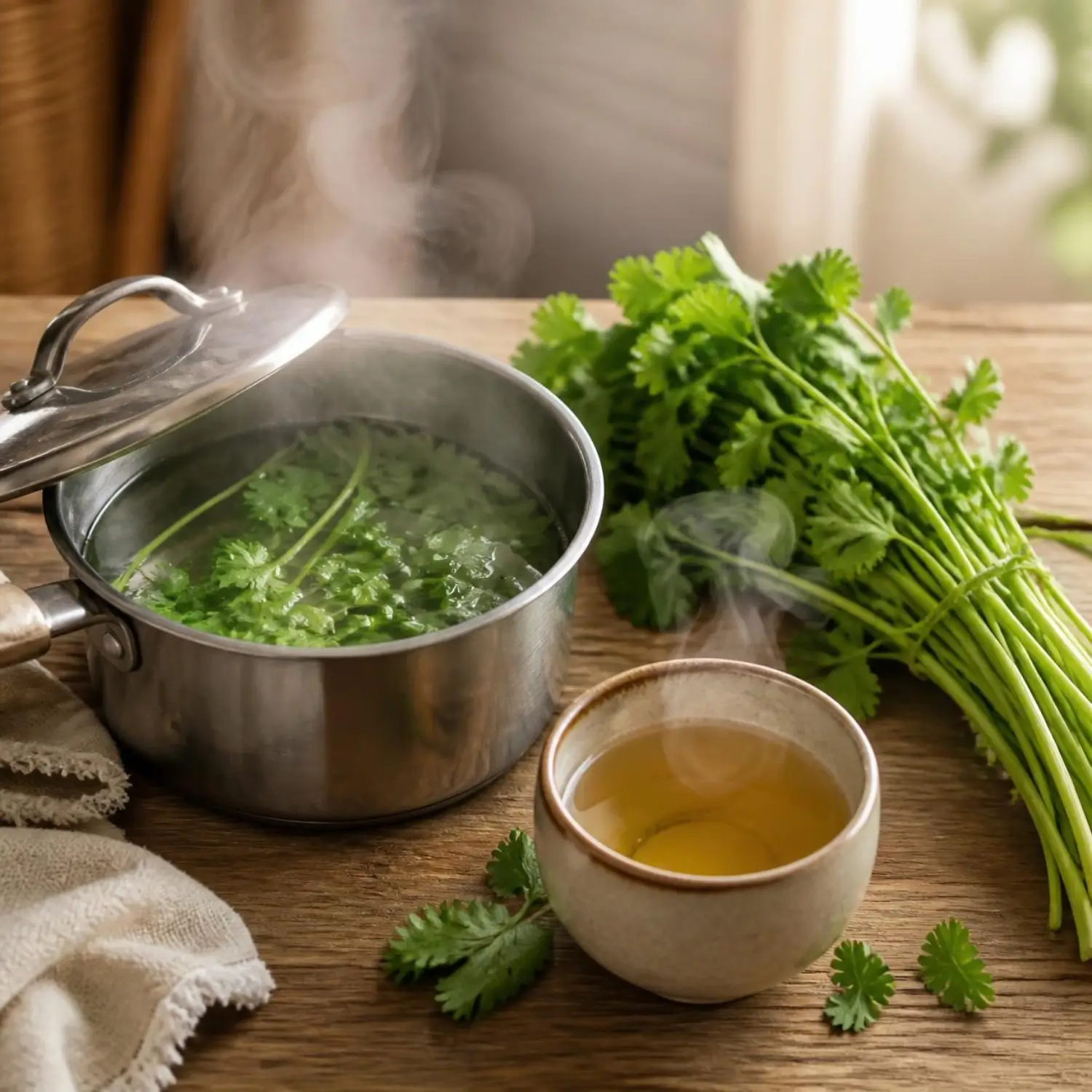
Coriander herbal tea recipe
Ingredients
- 400 to 500 ml of water
- a good-sized handful of fresh coriander, including stems and leaves
Preparation
- Pour the water into a saucepan.
- Add the fresh coriander right from the start.
- Cover.
- Bring gently to a simmer.
- Keep the infusion going for about 10 to 15 minutes, always with the lid on.
- Filter if necessary.
- Drink it hot.
In the tradition presented here, this preparation is intended to accompany a profile where the sensation of cold dominates.
The idea is therefore not simply to drink "a herbal tea for a cold", but to choose a preparation consistent with the observed symptoms.
What if I don't have coriander?
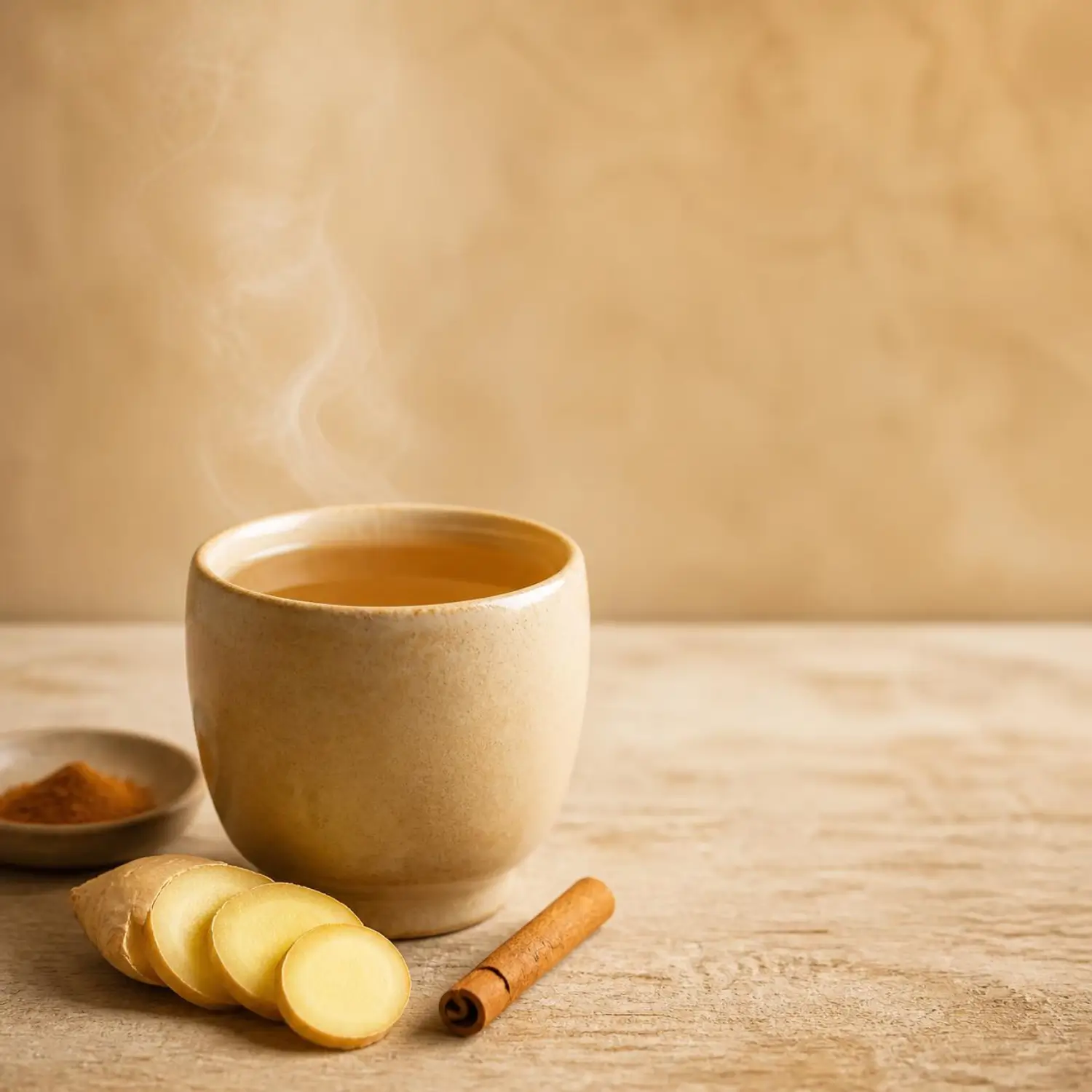
You can consider another warming preparation with ginger and cinnamon.
Ginger and cinnamon herbal tea: a warming alternative
Ingredients
- 400 to 500 ml of water
- 2 to 3 thin slices of fresh ginger
- 1 small piece of cinnamon, or about ½ to 1 teaspoon of ground cinnamon
Preparation
- Place the ginger and cinnamon in a saucepan.
- Add the water.
- Cover and bring to a simmer.
- Let it steep or simmer gently for 10 to 15 minutes.
- Filter.
- Drink it hot.
This recipe should also be considered as a warming preparation, and not as a universal herbal tea to be used regardless of the type of symptoms.
When the signs suggest heat
Conversely, some symptoms give more of an impression of heat.
Examples include:
- a significant feeling of heat;
- fever;
- an irritated throat;
- a burning sensation;
- a drier mouth.
In this situation, a very warming preparation is not necessarily consistent with the traditional approach presented here.
A lighter infusion: ginger, mint and chrysanthemum
Here is a recipe inspired by this logic.
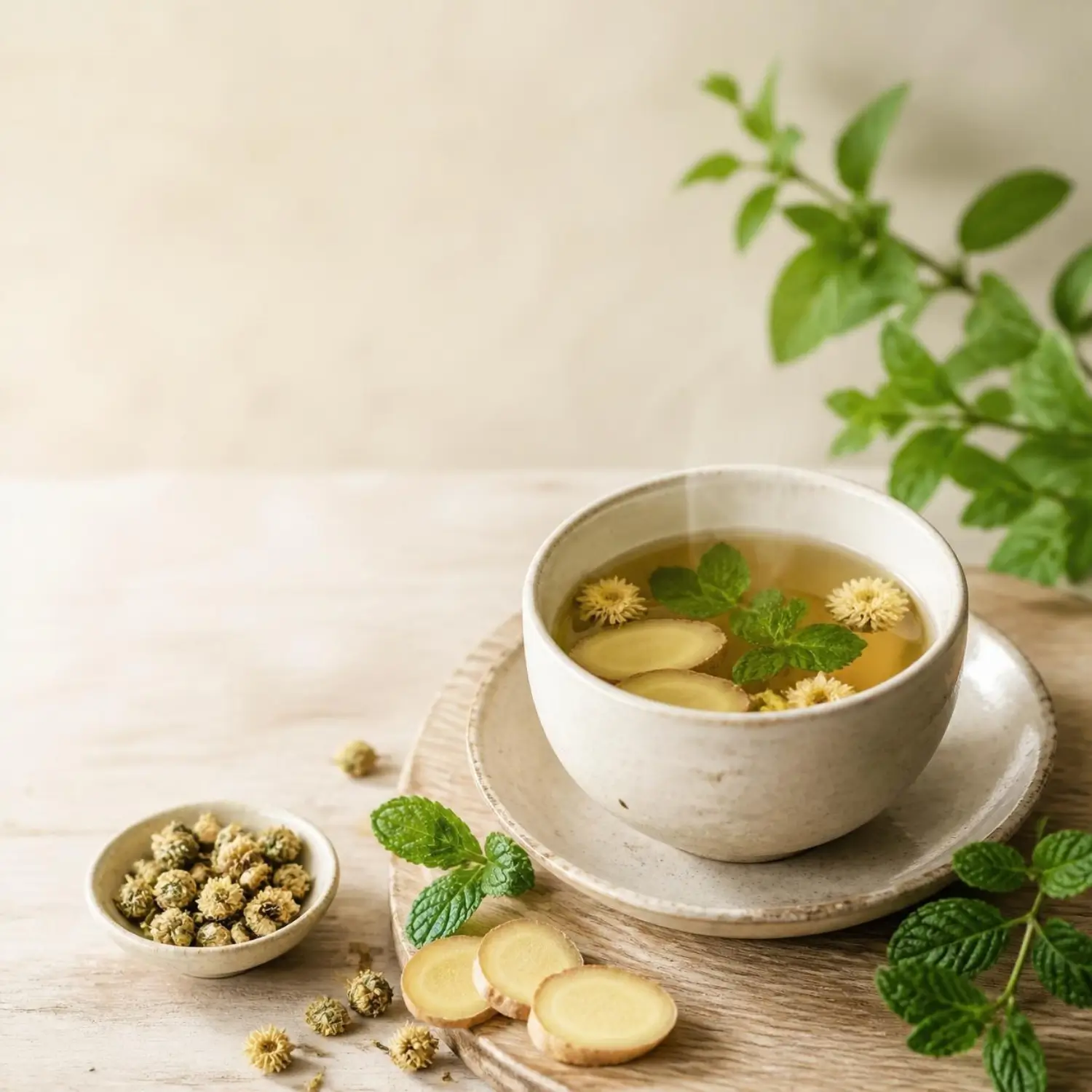
Ginger, mint and chrysanthemum flower herbal tea recipe
Ingredients
For approximately 300 to 400 ml:
- 2 to 3 thin slices of ginger;
- 1 small spoonful of dried chrysanthemum flowers;
- 1 small pinch of mint, or about 1 small spoonful.
Preparation
- Place the ginger and chrysanthemum flowers in a cup or teapot.
- Pour the hot water.
- Cover.
- Let it steep for about 8 to 12 minutes.
- Add the mint only at the end.
- Let it steep for 1 to 2 minutes.
- Remove the plants and then enjoy warm or hot, but not piping hot.
The goal here is to offer a lighter infusion when The sensation of heat and irritation predominate in the traditional reading of TCM.
Which herbal tea should you choose for a cold? The answer in 30 seconds
To easily remember the main points:
What you feel most |
In this TCM approach |
Preparation offered |
| Chills, cold, need to bundle up | "Cold" trend | Fresh coriander |
| No coriander available, feeling cold | Warming preparation | Ginger cinnamon |
| Sensation of heat, irritated throat | "Heat" trend | Light ginger, mint, chrysanthemum |
This table is intentionally simplified: in TCM, traditional observation is not limited to two boxes and personalized support is provided by a trained practitioner.
Can you really "cure a cold" with herbal tea?
It is important to distinguish between two things.
Herbal tea can contribute to comfortThis is particularly beneficial because it provides a warming liquid and contributes to hydration. However, it should not be presented as a treatment capable of eliminating the virus responsible for a cold.
The common cold usually resolves on its own. Medical recommendations emphasize hydration, rest, and measures to relieve symptoms.
The approach proposed in this article is therefore different: it consists of discovering How Traditional Chinese Medicine observes symptoms and traditionally adapts plants according to their dominant characteristic.
Good habits to associate with herbal tea
Regardless of the herbal tea chosen, a few simple measures remain important.
Drink regularly
Proper hydration helps prevent dehydration and is one of the recommended measures to accompany a cold.
To rest
Rest helps to reduce the stress on the body during the period when symptoms are present.
Taking care of the nose
In case of a blocked nose, washing the nasal passages with saline solution or a suitable solution can help relieve symptoms.
Don't try to "sweat at all costs"
That's an important distinction.
In some traditional practices, particularly for a predominantly "cold" climate, the aim may be to gently encourage a feeling of warmth. This does not mean inducing profuse sweating or excessive clothing.
In case of fever, medical recommendations tend to go in the opposite direction: it is advised not to cover up too much in order to allow body heat to escape.
When should you consult a doctor if you have a cold?
A cold is usually benign, but certain symptoms should prompt a medical consultation.
Consult a doctor promptly in the event of:
- difficulty breathing or swallowing;
- high fever, especially above 38.5 °C;
- severe headaches;
- vomiting;
- severe ear pain;
- sudden worsening of symptoms;
- symptoms that do not subside after 15 to 20 days.
People with certain chronic illnesses or immunosuppression should also be particularly careful and seek advice from their doctor.
Key points to remember
It doesn't necessarily exist a unique herbal tea for all colds in the approach of Traditional Chinese Medicine.
The idea is rather to observe the dominant signs:
❄️ Rather cold?
Chills, a feeling of cold, a need to cover up: a warming preparation like coriander, or failing that ginger and cinnamon, corresponds to the traditional logic presented here.
🔥 Prefer the heat?
Feeling hot, fever, sore throat: you can turn to a lighter infusion combining ginger, mint and chrysanthemum.
This reading primarily helps to understand Why the same recipe is not necessarily suitable for all situations.
And this is ultimately one of the interesting principles of TCM: before choosing a plant, one begins by observe the signs.